Table of Contents
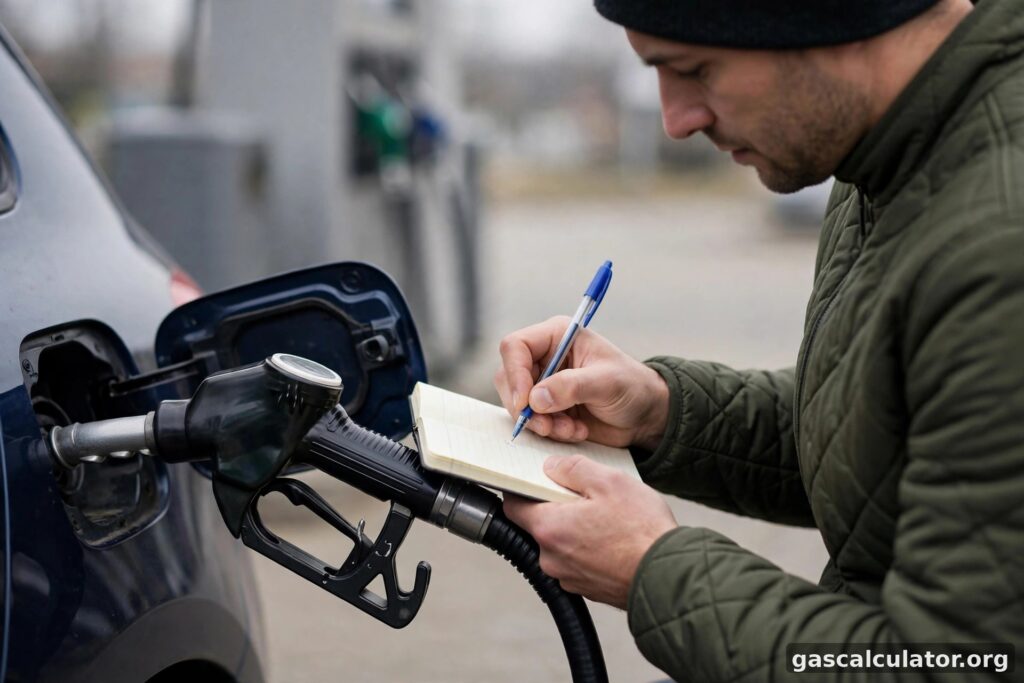
Every fill-up leaves a paper trail, and a gas mileage calculator is the tool that turns that trail into a number you can actually use. Miles divided by gallons sounds too simple, but the value shows up when you track it fill-up after fill-up: instead of guessing what your car costs to run, you see patterns — a slow slide hinting at mechanical trouble, or a steady climb proving your gentler habits work.
A single tank can mislead you. Short trips, a headwind, or a pump that clicks off early can swing one result by several MPG. Log a month of driving and feed the numbers into a gas mileage calculator, though, and the noise washes out. What remains is your car’s honest average — a baseline to compare against for as long as you own it.
What a Gas Mileage Calculator Actually Measures
At its core, a gas mileage calculator does one division: miles traveled divided by gallons consumed. Drive 300 miles, refill with 10 gallons, and you averaged 30 MPG. The manual method matters because your dashboard readout is only an estimate, often one or two MPG optimistic. The tank-to-tank method — fill completely, note the odometer, then divide miles by gallons at the next full fill — measures what actually went in and came out.
That is why the gas mileage calculator on this site asks for just two numbers per fill-up — miles since the last full tank, gallons just added — and returns a result that beats any sticker figure.
How to Use a Gas Mileage Calculator for a Full Month
The method works only if every fill-up is a full one, because the gallons added are assumed to replace exactly what you burned:
- Fill the tank until the pump clicks off on its own. Do not top off.
- Reset the trip odometer, or write down the main reading, and keep the receipt.
- Drive as you normally would — no special behavior, no test loops.
- At the next fill-up, fill completely again and record the gallons and miles.
- Enter both numbers and note the result in a simple log; a notes app works fine.
Repeat for at least four or five fill-ups before judging — our MPG calculator page runs the identical math for a single tank. By month’s end you’ll have something no brochure offers: your car’s real fuel economy in your weather, on your roads, with your right foot.
One Month, Three Fill-Ups: A Worked Example
Here is a realistic month from a compact sedan, logged fill-up by fill-up:
| Fill-up | Miles driven | Gallons added | MPG |
|---|---|---|---|
| 1 | 287 | 9.6 | 29.9 |
| 2 | 254 | 9.8 | 25.9 |
| 3 | 301 | 10.2 | 29.5 |
| Combined | 842 | 29.6 | 28.4 |
Fill-up 1: 287 ÷ 9.6 = 29.9 MPG, mostly highway commuting. Fill-up 2 drops to 254 ÷ 9.8 = 25.9 MPG — a week of short city trips and cold starts, so the dip is expected, not alarming. Fill-up 3 recovers to 301 ÷ 10.2 = 29.5 MPG. Any single row would mislead you; the honest figure is the combined one: 842 miles ÷ 29.6 gallons = 28.4 MPG. A gas mileage calculator shows both views, but the combined average is the number to compare next month.
What a Gas Mileage Calculator Trend Tells You About Your Car
Once you have a baseline, the log becomes an early-warning system. A sudden, sustained drop — say your 28 MPG car starts returning 23 across three tanks with no change in your driving — usually points to something specific:
- Low tire pressure. Under-inflated tires raise rolling resistance and wear tread shoulders. Check monthly; a few PSI low can cost 1–2%.
- A clogged air filter. A starved engine works harder; filters are cheap yet often go unchanged for years.
- Worn spark plugs. Old plugs misfire subtly long before failing outright; mileage is often the first symptom.
- Poor alignment. A car dragging itself slightly sideways burns extra fuel and eats tires unevenly.
- Extra weight and roof boxes. A hundred pounds of forgotten cargo, or a roof box left on all year, quietly taxes every mile.
- Winter fuel and cold weather. Winter-blend fuel carries slightly less energy and cold engines run rich longer; a seasonal dip of 1–2 MPG is normal.
Compare your log with the official ratings at fueleconomy.gov to see whether your car underperforms its peers or simply lives harder than the test cycle assumed.
Comparing Two Cars With a Gas Mileage Calculator Before You Buy
Window stickers are fine for a shortlist, but your own log is better evidence. Choosing between two cars, gather real-world numbers for each — from a long test drive or owner forums — and run them through a gas mileage calculator beside your current car’s logged average. A 4 MPG gap sounds small until you multiply it out: over 12,000 miles a year at $3.50 a gallon, a 24 MPG car burns 500 gallons ($1,750) while a 28 MPG car burns about 429 gallons ($1,500) — roughly $250 a year, every year. Pair that with a gas calculator estimate of your regular trips to see the true cost gap before signing.
An Honest Note on Hypermiling
Tracking mileage often sparks the urge to push it higher, and some hypermiling habits are genuinely worthwhile: accelerating gently, braking less by reading traffic ahead, correct tire pressure, removing the empty roof rack, and moderate highway speeds. Together these might realistically gain you 5–10%.
Other famous techniques are not worth it: drafting trucks, coasting in neutral, killing the engine at speed, or over-inflating tires beyond spec trades real safety for pennies. Your log’s job is to inform you, not dare you — take the easy wins and leave the stunts alone.
Frequently Asked Questions
How often should I check my gas mileage?
Log every fill-up, but judge the trend monthly — one tank is weather and traffic; four or five tanks are a pattern.
Why is my calculated MPG lower than the dashboard display?
Dashboard readouts are estimates and often run optimistic. The tank-to-tank method behind a gas mileage calculator measures actual fuel bought against actual miles driven — the more honest number.
Should I worry about one bad fill-up?
No. Short trips, a different pump, or a headwind can sink one tank. Worry only if the drop survives two or three fill-ups with your driving unchanged.
What is a good MPG figure?
It depends on the class: a hatchback in the mid-30s and a family SUV in the low-20s can both be perfectly healthy. Compare your log with the official rating for your exact model.
Does this work for hybrids?
Yes — hybrids burn gasoline the same way, so miles divided by gallons applies unchanged. Only pure EVs differ, using electricity instead of gallons.
Conclusion
A gas mileage calculator is less about one number than about the line that number draws over time. Log every fill-up for a month, trust the combined average over any single tank, and watch the trend: steady means healthy, sliding means investigate. It is the cheapest diagnostic tool your car will ever have.